The Vouté calendar begins with the month of November. In a word at the Vútè in Cameroon, November represents the first of January of the modern world. This month called DONNÉ’Ó is the period dedicated to communion with the Ancestors, with the deceased. Attention! This meeting with the ancestors in the sacred forest does not take place every year, but only during the even years (for example 2022) that the Vútè calls DAING MADJÉNÉ, that is to say the year of the termites called MADJÉNÉ. The odd years being simply devoted to maintaining cleanliness in and around sacred places. The DAING MADJÉNÉ is considered as a year of very great luck, happiness and blessing in the life of the people Vouté, that’s why it happens that the scholars (notables) make coincide the initiatory and traditional induction of the new Chief Vútè with the DAING MADJÉNÉ.
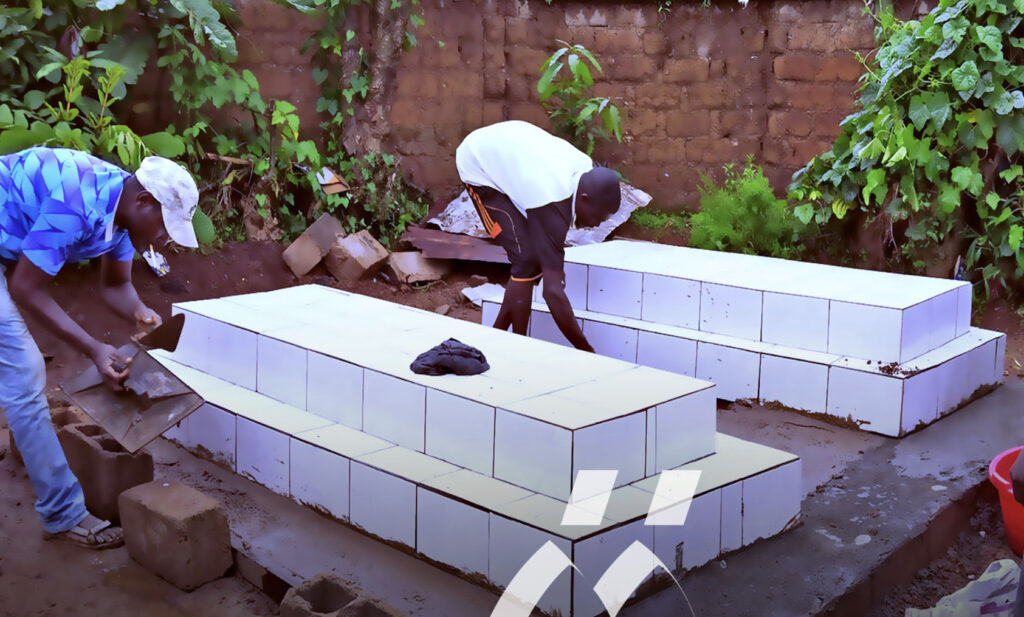
Les termites, notamment le MADJÉNÉ jouent un rôle très important dans la culture Vouté. On les répand souvent partout sur les tombes lors du FÓ’Ó en guise de RENAISSANCE. Le rituel du FÓ’Ó se déroule en deux phases : le nettoyage des tombes et des caveaux de tout le village, puis la cérémonie proprement dite. Il faut rappeler que la société Vouté était organisée de sorte que chaque village possédait trois cimetières : celui des Princes (GUEUM, mais du fait de sa sacralité, le mot NYAB DJIRI lui est préféré. Seul les Chefs et Princes y sont inhumés), celui des grands notables et le cimetière commun.
Around mid-November, the day set for cleaning, before sunrise and on an empty stomach, the whole village, to the sound of the bell tower (MESSENGUEP or KORONG) goes to the place, the King leading the troop. Once on the spot, the King knows precisely which sentences to pronounce and right away, we start working. The men with machetes clear while the women weed and pile up the weeds that will be cleared by the children. We start by making the tomb of the Creator Ancestors clean in chronological order, then we clean all the tombs of all the cemeteries of the village. Throughout the duration of the work, the bell tower (KORONG) keeps ringing.
In the end, when everything is clean, we share a drink (special and sweet MGBAH) with the workers and everyone goes home to wash and go about their business. On the day of the ritual of the ZIMBABWE’Ó itself, the fires are extinguished in all the kitchens of the village. In the early hours of the day, which is usually a Saturday (YE DEMIRI), always fasting and to the sound of drums (DJING DJÉNÉ) and the bell tower (KORONG), the whole village leads in columns and grouped by clans towards the sacred place (NYAB DJIRI). Everyone is required to have their work tools: hunters of their shotguns or trap cables, machetes and hoes for farmers, fishing line for fishermen, pens, pencils, school bags, notebooks, books… etc. for schoolchildren.
Foreigners as well as ordinary villagers stop under a first cheese maker almost halfway along the path that leads to NYAB DJIRI. The ruling family, it limits itself to the level of a second cheese maker, planted at the entrance of NYAB DJIRI. Only the King, his notables and his close family arrive at the tombs of the Founders of the village to complete the rest of the rites.
Subsequently, the Master of Ceremonies, an Initiate in unquestionable morality who is also Notable, proceeds to prepare the MOUM. It is a mixture of corn flour, a little water and some other ingredients that one kneads by hand while formulating wishes for blessings and prayers to the Ancestors and their God. We implore the Divine wisdom incarnated by that of the Ancestors for the resolution of the plagues that undermine the village, then we spray it on the instruments and tools of the participants (rifles, machetes, hoes, school bags,…etc.). This stage constitutes the culminating phase of the ceremony. Also, it is recommended to use all means and methods to leave this mass with at least a drop of MOUM blessed on oneself or on one’s work tool.
Bread (special and light meal that is made to be licked or better dripped in fresh rusk leaves) and wine (special and sweet MGBAH) are distributed first to the Chef, then to his entourage and then to the rest of the participants. At the end of this great mass, everyone collects a little fire from the cottage of NYAB DJIRI to go light it at home. The return to the village is marked by an impressive feast and festivities that will last until dawn: it’s THE RENAISSANCE.
Opportunities to visit sacred places do not only arise during the FO’O. If an important event or a decisive situation involving the life of the entire community occurs, the Chief and His Council of Notables have the right to go address the Ancestors. This is how, for example, when at the end of the month of December, the cold became unbearable, the Leader of Yoko went to this sacred place and addressed the Ancestors. In the evening, a fire was set there and from the morning of the next day, there was no more cold until the return of the next season.
It should be remembered that there is no improvisation when you have to go to the NYAB DJIRI. We go there very early in the morning, in a column to the sounds of DJING JENÉ and KORONG. But above all, one does not eat or have sexual relations with a woman even their own wife.
More and more, we are witnessing numerous dysfunctions and inconsistencies in the organization of this meeting with the Ancestors that can be justified by ‘DENWA’, that is to say ignorance. Inevitably, the Divine and Ancestral sanction is without appeal: decay, loss, panic, natural disasters, generations without diplomas, without employment, land taken away, famine, slavery, wars,… Etc.
One thing is true, our Ancestors are alive and well to the point that they know how to be heard by their methods. When you would like to build a house in the village on a hill, the Notables will require you to choose a site on the eastern side. The reason is quite simple: the sun rises in the East and sets in the West. Setting symbolizes death, rest. Our Founding Ancestors still rest on the west side of our villages. And it is hardly by chance that places of worship (churches, mosques, …etc.) are generally built on the eastern side, symbolizing for their followers the sunrise, hope, THE RENAISSANCE.
Interview, Hervé MBAKONG LOUK. Camera, Martin Magloire NJOYA, Emmanuel AWONO LOUK. Article by His Majesty Félix MELEM and Benjamin TANGA LOUK
COMPLEMENT :
- The great Vúté people did not only have an exemplary political-military organization focused mainly on their chieftainships. He also had a mastery of the notions of space and time that governed his warlike and socio-economic activities.
- In the Vouté culture, several ages are distinguished in the life of Man. From his birth until his death, the Man went from NANA to MOUTI, to FENDONG, to DUBER, to KIDJIRI and finally to NO NGOUNDJI. Nothing can be hidden from a NO NGOUNDJI because his age and experience crown him with wisdom. They are old men who never get angry and perpetually seek conciliation. Nowadays, this category of person can be recruited from 75 years old.
- There are things that a Traditional Chief Vútè can say or write publicly, others that he can only confide in person and others that he is not allowed to say at all…
Sources / References :
– My Tender Mom, source of my inspiration, left on February 13, 2009.
– Talks with His Majesty Félix MELEM.
– Talks with My Parents and Grandparents (His Majesty Djibril SANGOUING WOURI, His Majesty Moise YANGOU, Jean-Claude WOURI, Oumarou LOUK, Martin NYOYA, François TIMENE, Issa NDJIBE).
– Video support, Issa NDJIBE, Great Notable of the YANGBA Village, 105 years old.