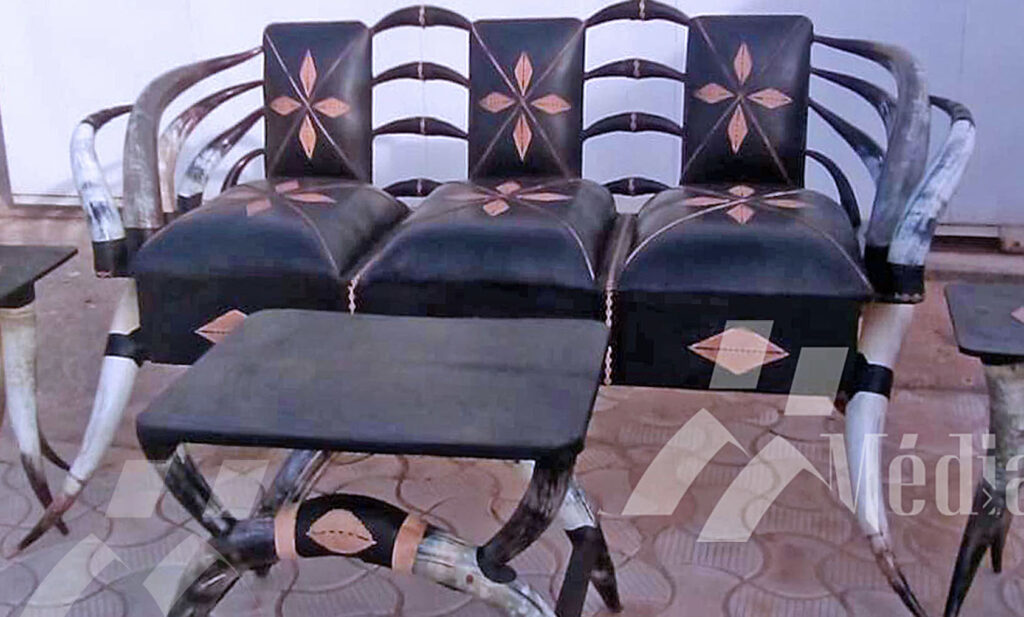
In the busy streets of Maroua, where the sun of the Far North of Cameroon warms every stone and soul, a man was able to transform shame into pride, mockery into admiration. Mohamadou Nourou, an artisan sculptor and visionary, has made recycling a work of art and a path to social redemption. This story is that of a fight, an unwavering determination, and a talent that today illuminates well beyond the borders of Cameroon.
A departure in adversity
Born in 1984 in Ngaoundéré in Adamaoua, into a modest family, Mohamadou Nourou did not follow the classic path dreamed by many. After studying carpentry at the technical high school in Maroua, he obtained a CAP, then continued until first year at the technical high school in Bertoua. But the financial pitfalls force him to abandon school for the harsh reality of working life. With courage and creativity, he turns to craftsmanship, an area that he transforms into a field of innovation.
It was in 2006 that its trajectory took a decisive turn. During a chance meeting with a Senegalese artisan, Mohamadou discovers the unsuspected potential of beef horns. While they were previously considered as worthless waste, he imagines how this material can become both useful and artistic. His first creation, a beef horn table, sells for 70,000 FCFA, a significant sum that opens the doors to a new horizon.
The creation process : from garbage to jewelry
Every day at dawn, Mohamadou goes to one of the three slaughterhouses in Maroua, a town where more than 150 cattle are slaughtered daily. On the spot, he meticulously sorts the horns, pays for his raw material and carries his findings in often malodorous bags. The mockery is flying, the moto-taxis refuse to transport him, but nothing shakes him. He knows that these «waste», once worked, will become unique objects.
The process is rigorous: sorting, extraction of the cornion (the bone substance inside the horn), washing with chlorinated water and detergent, then transformation. With his carpentry tools and electric machines – jigsaw, grinding wheel, chignole – he shapes the horns to create tables, armchairs, jewelry, and much more. Each piece, whether utilitarian or decorative, is the result of a work of goldsmith. For example, a chair requires eight perfectly matched horns, dressed in leather and foam according to the orders.
The reward of boldness
Despite beginnings marked by shame and ridicule, Mohamadou Nourou has managed to gain the respect of his community. His first exhibition at the National Festival of Arts and Culture (FENAC) in 2008 is a success, as is his participation in the International Trade Fair of Cameroon (SIARC) in 2009, where he exhibits in Yaoundé, the capital. During the third edition of SIARC in 2012, it won the first prize for waste recycling, confirming its pioneering status in this field.
His journey has taken him beyond national borders, with participations at the International Craft Exhibition of Ouagadougou (SIAO) in 2017 and a remarkable invitation to Casablanca, Morocco, for a live demonstration of his know-how by an individual. At each step, Mohamadou redefines the image of recycling, making it a true artistic discipline and a source of pride.
A model for young people and the future
“Myself, I was ashamed of myself at the beginning, but I had the determination and the desire to create,” he confides with palpable emotion.
Aujourd’hui, cet homme autrefois traité de fou est devenu une figure inspirante. Son travail est respecté, et sa personne admirée. Il a redonné ses lettres de noblesse à une matière délaissée, prouvant que le talent et l’ingéniosité peuvent transformer la perception collective.
Mohamadou Nourou does not intend to stop there. He is currently preparing a project in Yaoundé to introduce other people to recycling, showing them that this field is a real career in its own right. With contagious enthusiasm, he hopes to inspire a generation to embrace professions that not only respect the environment but also elevate the human soul.
The horn is more than a material for him; it has become a symbol of rebirth. And in the streets of Maroua, Ngaoundéré… and beyond, when he walks today, it is no longer with bags of horns under the mockery, but with his head held high, under the admiring glances of those he was able to inspire.