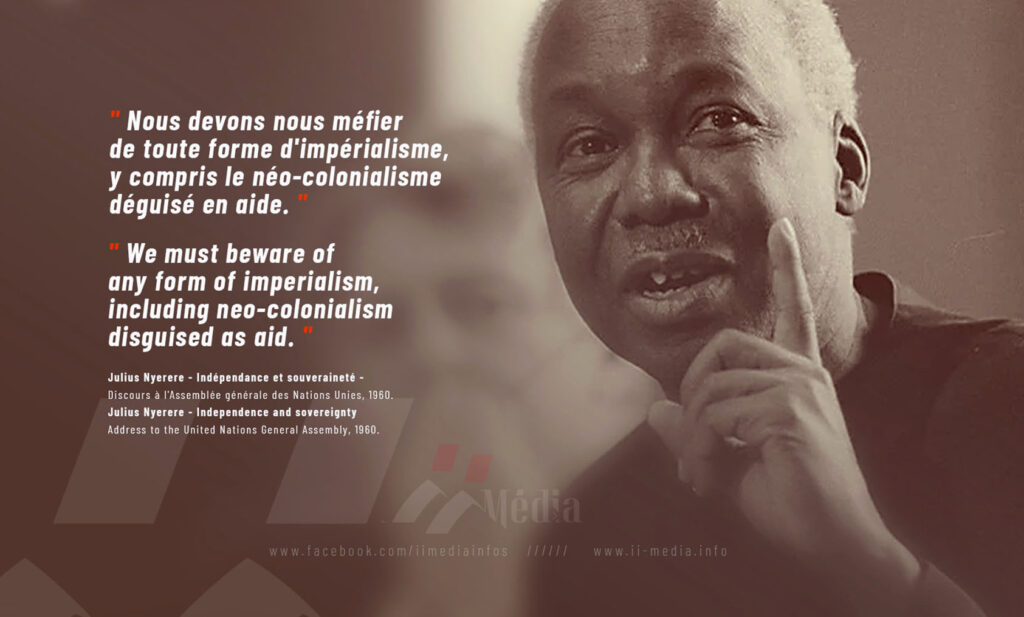
At the heart of decolonization movements, Julius Kambarage Nyerere, nicknamed “Mwalimu” (“the teacher” in Swahili), has established himself as a leading figure of an Africa in search of identity, unity and autonomy. More than just a head of state, he was a visionary whose thought and action are deeply rooted in African culture, realities and aspirations, far from any exclusive reference to Western paradigms. His legacy further illuminates the path towards a truly African development, based on dignity, solidarity and sovereignty.
Unity beyond ethnic boundaries: an African model of cohesion
In a continent often marked by ethnic and political fragmentation, Nyerere managed to build Tanzania on the basis of a union that transcends these divisions. His promotion of Kiswahili as a common language was a revolutionary step to forge a unified national identity. This approach, rooted in respect for local cultures while building a sense of collective belonging, illustrates traditional African thought where the community takes precedence over division. This quest for unity finds echoes in other visionary African actors: Kwame Nkrumah from Ghana, promoter of Pan-African unity, Léopold Sédar Senghor from Senegal, theorist of blackness valuing culture as the foundation of development, and Cheikh Anta Diop from Senegal, who emphasized the importance of African roots in the construction of knowledge and modernity. In this, Nyerere is part of a deep pan-African current, which rejects the idea of imposed development from the outside to promote a shared destiny.
Education, a weapon of liberation and a lever for endogenous development
The nickname «Mwalimu» is not trivial: for Nyerere, education was not limited to the transmission of technical knowledge but should emancipate minds and build a collective consciousness. He wanted an education accessible to all, capable of producing critical citizens, autonomous and bearers of the African project. The importance given to education is also found in Julius K. Nyerere’s teaching of dignity and humanistic values rooted in local knowledge. Other leaders, such as Thomas Sankara in Burkina Faso, have also focused on education as a lever for social transformation, linked to health, agriculture and the local economy.
Ujamaa: a human socialism inscribed in the African tradition
The ideology of “Ujamaa”, or “extended family”, developed by Nyerere, illustrates a deeply African political and economic vision: community solidarity, sharing and cooperation, far from imported materialistic dogmas. Inspired by both socialism and traditional African values where land and resources are considered as a collective heritage, the Ujamaa called for voluntary collectivization, economic self-sufficiency and a rejection of neocolonial and unequal capitalism. Although the implementation of the Ujamaa has encountered difficulties on the economic level, this project poses an ethical alternative that is still relevant today, particularly in the face of growing inequalities stigmatized as consequences of globalization and neocolonialism.
This dream of an African socialism is found in other African figures such as Kwame Nkrumah who advocated the economic liberation of the continent, or Thomas Sankara who saw community solidarity as the key to autonomous development.
A vibrant news in the face of the continent’s contemporary challenges
Today, many African countries, particularly in the Sahel region, embody this desire for autonomy and sovereignty that Nyerere defended. The Alliance of Sahel States (AES) — grouping Burkina Faso, Mali and Niger—illustrates this desire to break with dependence on foreign powers, to value local resources and to think about endogenous development. In this quest, the thought of Nyerere finds a particular echo, just like that of Sankara, Patrice Lumumba or Félix Houphouët-Boigny, who each, in their own way, showed that it was necessary to rely on cultural roots and community ties to build an African future.
An invitation to rethink African development on its own terms
The legacy of Nyerere is not to promote a rigid model or a backward-looking return, but to offer an ethical compass to invent a future that is both African and modern. This vision places at the heart of development:
- the centrality of man with his values, culture and aspirations,
- the primacy of education as a driver of emancipation,
- community solidarity for a fair sharing of wealth,
- sovereignty in political, economic, and cultural choices.
- This approach thus invites us to overcome the dependence on foreign models, often unsuited to African realities, in order to conceive a development based on the strength of peoples themselves.
Julius Nyerere, through his life and work, embodies a fundamental challenge: to think of Africa from its own roots, its values and its collective will. Neither pessimistic nor naive utopian, the “Mwalimu” proposes a path where dignity, social justice and solidarity are not simple ideals, but indispensable foundations for any political and economic construction.
More than ever, at a time when the continent is seeking to break cycles of dependence, its heritage encourages us to look towards an African development, invented by Africans and for Africans, inspired not by Western patterns but by the deep wisdom of African societies. In this, Nyerere remains a master of thought, an inspiring teacher for present and future generations, a beacon for a sovereign, just and free Africa.