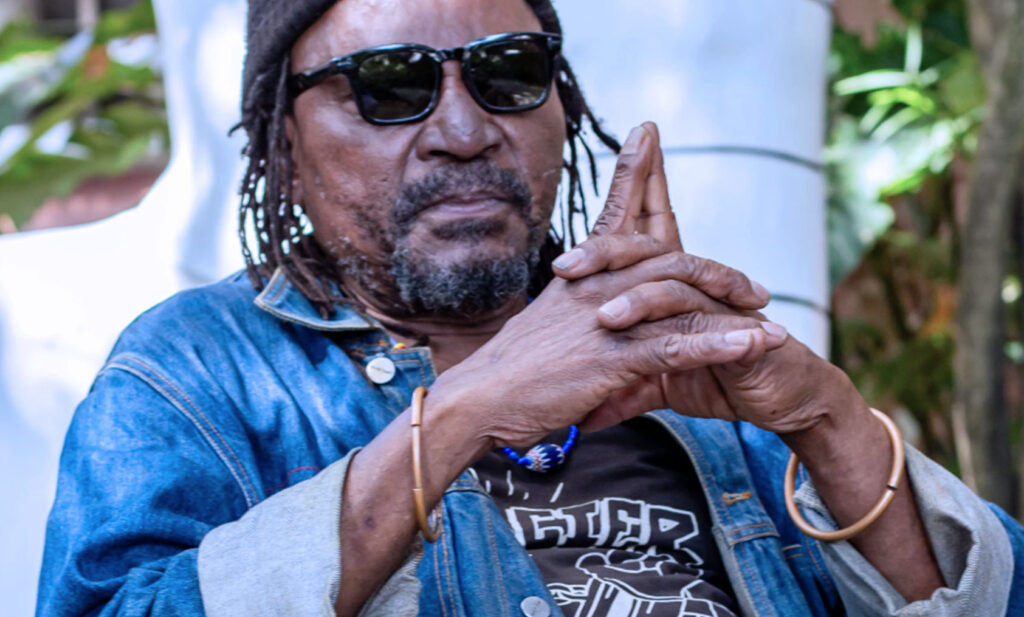
Koko Komégné, whose real name is Gaston Komégné, was born on October 2, 1950 in Batoufam, a small village in western Cameroon, into a family of planters. Very early on, he was plunged into a rich and varied musical universe, mixing Congolese music, merengue and chatchatchatcha, which would mark his artistic imagination. In 1956, he was sent to Yaoundé where he studied until the CM2 level, and began to draw, making his first sculpture, “Le Boxeur”, between 1960 and 1962, a work made from a heated and hammered deformed nail, kept for a long time at home.
At 14 years old, he returns to his native village to rediscover his roots, the local culture, dances, mysteries, and imagination passed down by his grandmother, elements that will inspire him all his life and nourish his artistic identity. In 1965, he moved to Douala where he met Jean Sabatier, an amateur French painter who influenced him to start painting. In 1966, he opened his first studio, practicing reproducing works by masters such as Van Gogh and Picasso, while earning a living by making advertising panels.
Very quickly, Koko Komégné seeks to move away from Western figurative art to create a personal aesthetic, mixing semi-abstraction and expressionism, integrating strong references to traditional African art, notably through stylized masks and ritual motifs. He illustrates faces and bodies in motion, as if dancing, giving an almost musical dynamic to his paintings. His painting is marked by a diversity of styles—cubism, surrealism, tachism — on backgrounds permeated with Africanity.
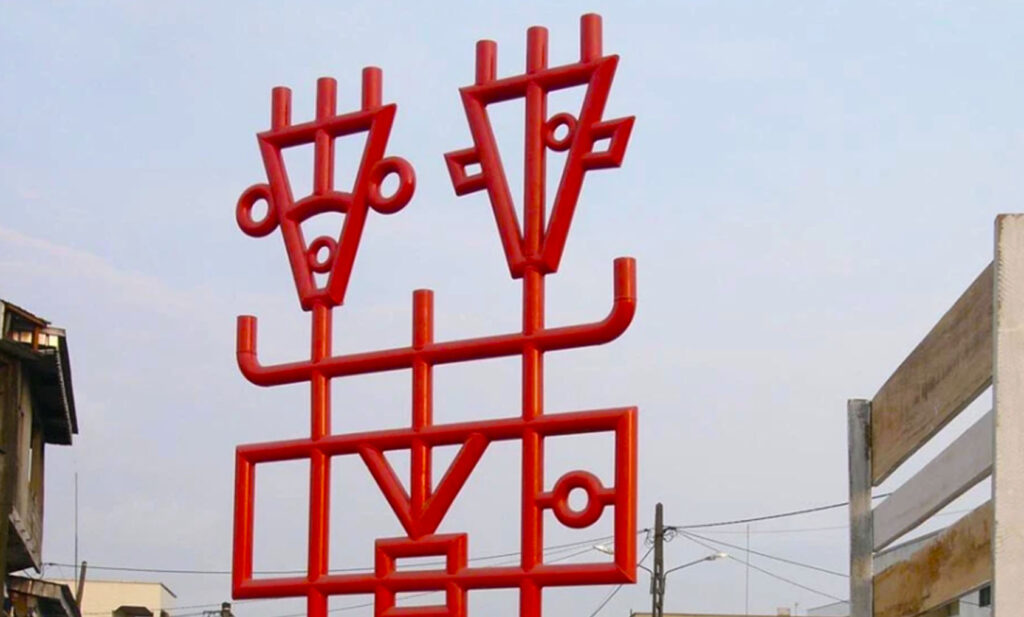
In addition to painting, Koko Komégné is also a sculptor. Among his monumental works, “Njé Mo Yé” (2007), a sculpture in iron tubes representing and magnifying the couple, permanently marks the urban landscape of Douala. His sculpture ‘Kongné’ adorns the facade of the Baham Bird museum, and the monumental ‘Nanga Def’ (2024) testifies to his contemporary exploration of African symbols, paying tribute to his artistic friendships.
Musician at heart, he was also a singer and percussionist in the group Black Power, embodying a multifaceted sensitivity between visual arts and music. Despite hardships, including a serious accident in 1997, Koko Komégné continued to create and inspire generations of African artists. His long artistic career, started in 1966, celebrated its 50th anniversary in 2016 with a retrospective gathering more than 200 works.
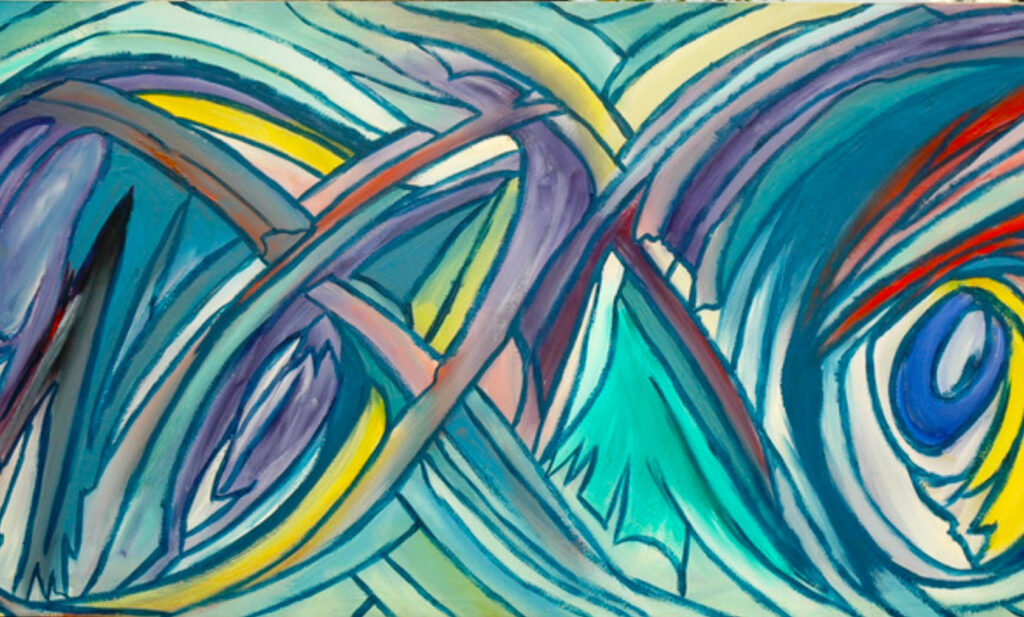
Koko Komégné is considered the father of contemporary Cameroonian art. His work, rich in shapes, colors, movements and symbols, is a bridge between tradition and modernity, memory and avant-garde. He is also an art philanthropist, convinced that artistic practice must above all make the artist human, more than simply seeking material wealth.
Koko Komégné passed away on October 28, 2025 in Douala, leaving behind an immense heritage, vibrant with energy and culture, a true monument of contemporary African creation.